

Carga de la enfermedad y necesidades insatisfechas
Carga de la enfermedad NF1-NP
Posible impacto en la vida cotidiana
Síntomas físicos
- Dolor
- Deterioro de la movilidad
- Desfiguración
- Discapacidad visual
- Obstrucción de las vías respiratorias
- Compresión de la médula espinal
- Tumores que ejercen presión sobre los órganos
Impacto psicológico
- Depresión
- Ansiedad
- Aislamiento
- Estigma
- Vergüenza
- Miedo al cáncer
- Deterioro de la salud sexual
Déficits cognitivos
- Incapacidad para centrarse
- Deterioro de la memoria
- Deterioro de la función visual y motora
- Dificultades de aprendizaje
Dolor y desfiguración: Preocupaciones clave en todas las edades
Entre todos los grupos de edad, dos de las preocupaciones notificadas con más frecuencia entre los pacientes con NF1-NP son el posible dolor y los posibles cambios en el aspecto físico.3
En niños y adolescentes, se ha descubierto que el dolor afecta su calidad de vida, incluso cuando se utilizan analgésicos.4
NF1-NP: un complejo desafío clínico
Crecimiento y distribución tumoral
El comportamiento de crecimiento de los NP es impredecible, con periodos de rápida expansión que se alternan con fases de relativa inactividad.6
La cirugía para tratar la NF1-NP no siempre es factible, y los resultados pueden ser variables.7
Tratamiento quirúrgico: Limitaciones y resultados
Históricamente, la opción de tratamiento principal para los NP ha sido la resección quirúrgica; sin embargo, los tumores irresecables, las resecciones incompletas y la recidiva tumoral pueden limitar la utilidad de las intervenciones quirúrgicas.8
La cirugía de la NF1-NP suele verse limitada por la naturaleza infiltrante de los tumores, su ubicación anatómica y su proximidad a nervios y vasos sanguíneos.2
Incluso cuando la cirugía es factible:
- En muchos casos no es posible extirpar completamente un neurofibroma plexiforme (NP).9
- Aproximadamente el 50 % de los pacientes tienen tumores que no se pueden extirpar por completo.10
- Incluso tras resecciones completas confirmadas, el 20 % de los tumores pueden volver a crecer.10
La necesidad de más opciones terapéuticas
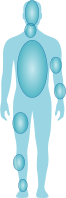
Sitios frecuentes de los NP5
Referencias
- Copley-Merriman C, Yang X, Juniper M, et al. Natural History and Disease Burden of Neurofibromatosis Type 1 with Plexiform Neurofibromas: A Systematic Literature Review. Adolesc Health Med Ther. 2021;12:55–66. doi: 10.2147/AHMT.S303456.
- Fisher MJ, Blakeley JO, Weiss BD, et al. Management of neurofibromatosis type 1-associated plexiform neurofibromas. Neuro Oncol. 2022;24(11):1827–1844. doi: 10.1093/neuonc/noac146.
- Lai J-S, Jensen SE, Patel ZS, Listernick R, Charrow J. Using a qualitative approach to conceptualize concerns of patients with neurofibromatosis type 1 associated plexiform neurofibromas (pNF) across the lifespan. Am J Med Genet A. 2017;173(1):79–87. doi: 10.1002/ajmg.a.37987.
- Wolters PL, Burns KM, Martin S, et al. Pain interference in youth with neurofibromatosis type 1 and plexiform neurofibromas and relation to disease severity, social-emotional functioning, and quality of life. Am J Med Genet A. 2015;167A(9):2103–2113. doi: 10.1002/ajmg.a.37123.
- Prada CE, Rangwala FA, Martin LJ, et al. Pediatric plexiform neurofibromas: impact on morbidity and mortality in neurofibromatosis type 1. J Pediatr. 2012;160(3):461–467. doi: 10.1016/j.jpeds.2011.08.051.
- Mrugala M et al. Disease burden and unmet needs in adults with neurofibromatosis type 1 and plexiform neurofibromas: A systematic literature review. Neurooncol Adv. 2026;vdaf269. doi: 10.1093/noajnl/vdaf269.
- Nguyen R, Dombi E, Widemann BC, et al. Growth dynamics of plexiform neurofibromas: a retrospective cohort study of 201 patients with neurofibromatosis 1. Orphanet J Rare Dis. 2012:7:75. doi: 10.1186/1750-1172-7-75.
- Ejerskov C, Farholt S, Nielsen FSK, et al. Clinical characteristics and management of children and adults with neurofibromatosis type 1 and plexiform neurofibromas in Denmark: a nationwide study. Oncol Ther. 2023;11(1):97–110. doi: 10.1007/s40487-022-00213-4.
- Yang X, Desai K, Agrawal N, et al. Treatment, resource use and costs among pediatric patients with neurofibromatosis type 1 and plexiform neurofibromas. Pediatric Health Med Ther. 2020;11:421–428. doi: 10.2147/PHMT.S265690.
- Armstrong AE, Belzberg AJ, Crawford JR, et al. Treatment decisions and the use of MEK inhibitors for children with neurofibromatosis type 1-related plexiform neurofibromas. BMC Cancer. 2023;23(1):553. doi: 10.1186/s12885-023-10996-y.
- EZMEKLY® (mirdametinib). Agencia Europa del Medicamento. Ficha técnica. Dublín, Irlanda:SpringWorks Therapeutics Ireland Limited; 2025.
- KOSELUGO® (selumetinib). Agencia Europa del Medicamento. Ficha técnica. Södertälje, Suecia:AstraZeneca AB; 2026.